The Echoes of Nazism in Today’s America: History or Hype?

Is anyone else heartbroken and equally fascinated by what’s happening in America right now? The removal of the statue of Confederate general Robert E Lee from a public park in Charlottesville, Virginia, on 13 August sparked demonstrations which culminated in the tragic death of a 32-year-old woman, Heather Heyer.

But had it not been for Trump’s subsequent statement, then perhaps Heather’s death and these demonstrations could have been recorded as a local (though tragic) event. Heather may have been seen as “just one more casualty” in a long violent history between right-wing nationalists nostalgic about the old South, and everyone else that enthusiastically excludes themselves from that label.

rump-speech-hero-1_fynh2w

President Trump threw fuel on the metaphorical fire by saying, “We condemn in the strongest possible terms this egregious display of hatred, bigotry and violence on many sides, on many sides.”

But then President Donald Trump condemned the violence at a white supremacist rally “on many sides.”

“On many sides”……? Huh?

It’s been remarkable to watch the visceral uproar following Trump’s trivializing remarks. Scheduled “Free Speech” demonstrations in Boston last weekend were overwhelmed with counter demonstrators numbered in the tens of thousands. At the base of Trump Tower in NYC another 1,000 protesters shouted “Black Lives Matter,” while various sand-filled white dump trucks were positioned as a barricade. And comedian Tina Fey devoured an entire sheet cake:

Tina Fey

Tina Fey reminded white supremacists that: “It’s not our country–we stole it. We stole it from the Native Americans. And when they have a peaceful protest at Standing Rock, we shoot at them with rubber bullets. But we let you chinless turds march through the streets with semi-automatic weapons.”

Even other world leaders unequivocally condemned the white supremacists. In Germany, where any Nazi salutes, gatherings or symbols are illegal (even arresting tourists who flout the law), politicians have tweeted their dismay.

Martin Schulz, leader of Germany’s Social Democratic Party, tweeted: “One must denounce Nazis definitively. What Trump is doing is inflammatory. Whoever trivializes violence & hate betrays western values.” German Chancellor Angela Merkel called the events in Charlottesvile “absolutely repulsive.” And former Israeli Foreign Minister, Tzipi Livni, tweeted: “In Nazism, anti-Semitism and racism there are never two equal sides — only one side is evil. Period.”

And some of the strongest voices of all are those of Holocaust survivors and veterans of the Second World War. These brave people are standing up against any revival of the same racist intolerance they experienced in 1930s Germany.
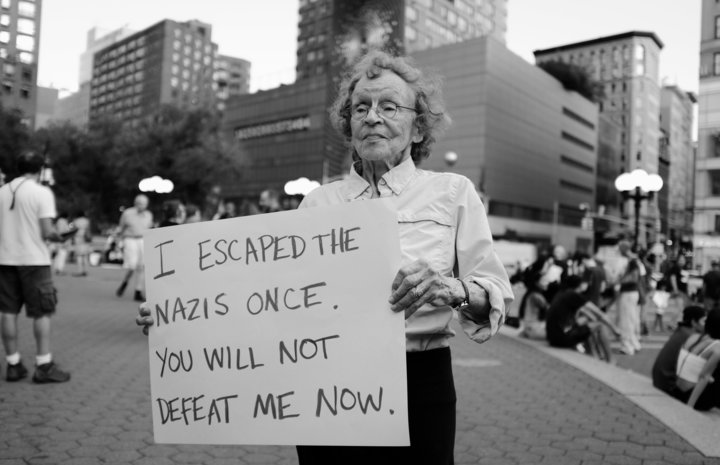
Rubin Holocaust Survivor

Marianne Rubin’s granddaughter, Lena Schnall, captured a photo of her grandmother at a rally in NYC after Charlottesville. Rubin was a Jewish child in 1930s Germany and managed to escape with her parents first to Italy, France and then the US.

But are today’s racial clashes in the US actually echoing the same sentiments of Nazi Germany? Is Trump the new Hitler? Are Muslims and refugees the new Jews? Is World War III around the corner? Or is this all just a bunch of short-lived hype that will shortly disappear? 

Professor Richard J. Evans (my favourite historian and eminent Cambridge scholar) was interviewed by Slate magazine shortly after Trump’s inauguration. Well before the events of Charlottesville, Prof. Evans suggested that some parallels can be drawn between Trump and Hitler’s early days in power. I will now elaborate on three points my biggest intellectual crush raised:

1. The stigmatization of minorities.

Hitler despised those he deemed non-German. Although Hitler was a notorious anti-Semite, his prejudice towards Jews also extended to Bolshevists and progressive liberals who endorsed the Weimar Republic. Importantly, a strong right-wing community supported Hitler, which blamed Germany’s defeat in WWI upon the socialists, communists and Jews that had back-stabbed them on the homefront.  Anti-Semitic newspapers and anti-Jewish clubs were commonplace in prewar Germany.

And, once you combine this common hatred with a socially-acceptable belief in “scientifically-measurable” progression and eugenics (which was studied in numerous universities since Darwin coined the idea of “evolution”), then it’s not difficult to see how even the most civilized of societies – which Germany was in the 20th century – could believe that one race was superior to another. By 1935, the Nuremberg Laws solidified the legal persecution of Jews on the basis of “race” and by 1939, Jews were forced to wear yellow stars in public, moved into ghettos and eventually exterminated in concentration camps. Notably, this stigmatization was also experienced by other minorities, such as the disabled, homosexuals, political opponents, criminals, Roma/Gypsies, black people, religious groups…
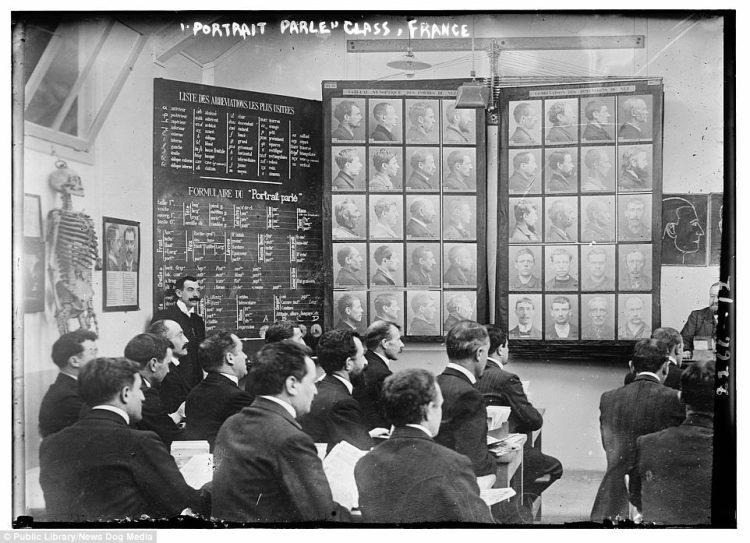
Eugenics

A class studies the Bertillon method of criminal identification, based on measuring body parts in Paris between 1910-1915. Eugenics was practised throughout the world and was considered to be ground-breaking field of scientific research which would improve society as a whole.

Today’s America is obviously a far cry from outright genocide, but stigmatization of minorities still exists. For example, Trump’s travel ban imposed against people from Iran, Libya, Syria, Somalia, Sudan and Yemen, as well as all refugees caused huge controversy last February. Trump claimed he was protecting American borders from Muslim extremists, despite the fact that only three refugees in American history (Cubans in the 1970s) were ever convicted of terrorism.
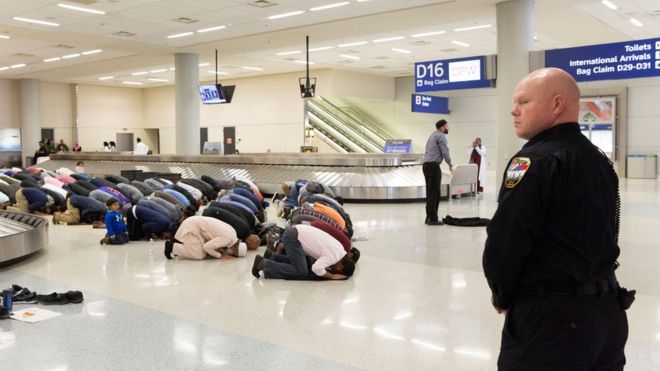
Muslims in protest

Muslims pray in protest of Trump’s travel ban in Dallas earlier in 2017. Although  judges have overturned the order, aspects of the ban were implemented and will be reviewed by the US Supreme Court in October.

Trump’s attempts to reverse Obamacare could also be perceived as a stigmatizing the poorer segments of American society who cannot afford private healthcare. The ongoing struggle of the #BlackLivesMatter black-community against state violence and discrimination is still speaking out against various Trump policies (although the 2012 murder of Trayvon Martin which sparked the movement occurred before Trump took office).  Also, the Trump administration announced last month that transgendered individuals would be banned from serving in the US military. Even some of the most conservative Republicans and retired military generals have denounced the policy.
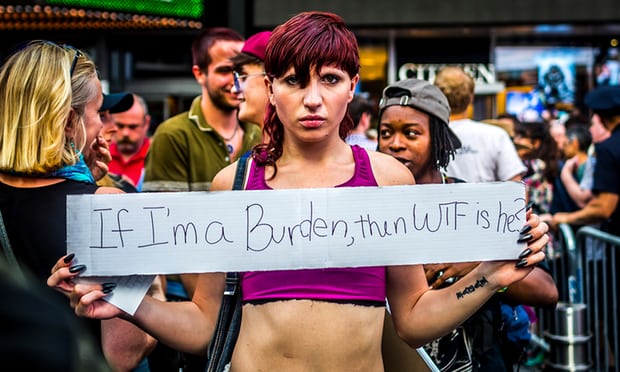
transgender

In August 2017, civil rights groups have announced their intent to file suit against Trump for the intended ban against transgendered people serving in the military.

2. Not adhering to conventions of normal political life.

Although the Nazi party won 37% of the vote through an entirely democratic and legitimate political process, Hitler’s almost immediately changed German laws to create a one-party state. Although historians cannot agree over who exactly burnt down the Reichstag –  Germany’s parliament – afterwards Hitler enacted emergency measures which allowed him to suspend German citizens’ rights, including habeas corpusfreedom of expressionfreedom of the press, the right of free association and public assembly, the secrecy of the post and telephone. Hitler never reinstated these rights during the Third Reich. This was, again, in the name of protecting German citizens from domestic terrorism.  In June 1934, Hitler also violently eliminated about 100 rivals in a violent purge called “Night of the Long Knives.” Then, after President Hindenberg’s death in August 1934, Hitler merged the presidency with the chancellorship. Incredibly, Hitler consolidated his power and created a violent dictatorship in less than two years.
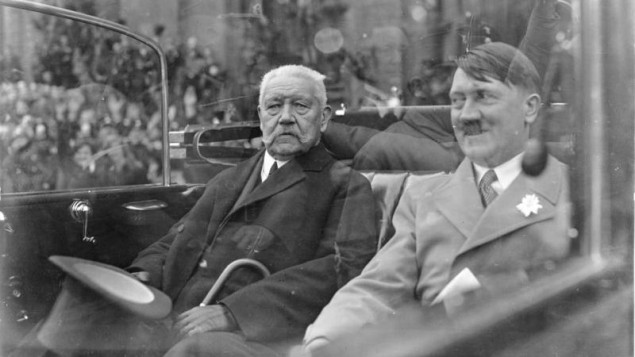
Hitler HIndenberg

President Paul von Hindenburg and newly-elected Chancellor Adolf Hitler in a parade in Berlin in 1933. By consolidating the roles of presidency and chancellorship shortly after Hindenburg’s death in 1934, Hitler was able to create a secure dictatorship.

What about Trump’s adherence to normal political life? Trump’s administration has passed more Executive Orders than any other president since Roosevelt, but many of these orders are politically insignificant (such as designating buildings or naming people to certain positions). However, the controversies surrounding Trump, especially with regard to Russia hacking the US elections and the dramatic resignation (dismissal?) of FBI Director James Comey, throw doubt on Trump’s ability to “adhere to normal political life.”  What about Trump barring certain journalists from the White House press room? Or the appointment of his daughter Ivanka Trump, and husband, Jared Kushner, as “special advisors” and even representing the US government at the latest international G20 conference? Or the fact that less than a year into the job, some seven high ranking officials were either sacked or resigned from the Trump administration?

Sean Spicer

After White House Press Secretary, Sean Spicer‘s resignation, he said what has been claimed as the most Sean Spicer thing ever: “You can keep taking your selfies.” Huh?!

3. Spurning international agreements.

A month after Hitler came to power, he withdrew Germany from the League of Nations. He argued that the Disarmament Conference did not allow it military parity with the Western nations (meaning that Hitler wanted to rearm and the Allies wouldn’t let him).  Hitler obviously would not agree to any international policy that would limit Germany’s autonomy. He continued to flout international laws by annexing Austria and invading the Sudetenland without any hassle from the French, British or Soviets. Well, not until he invaded Poland.
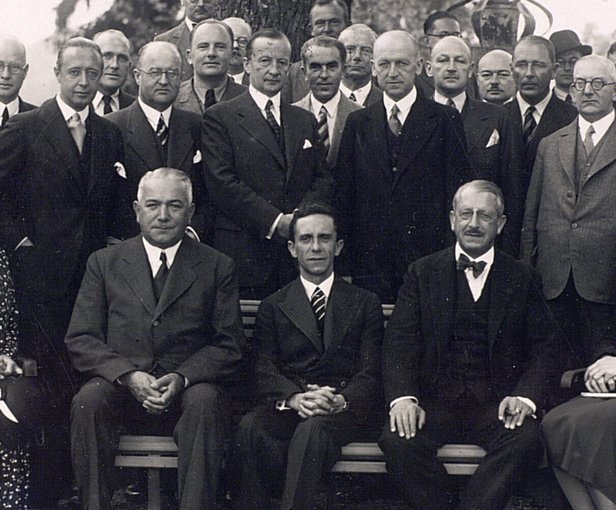
Goebbels at Geneva

Propaganda Minister Joseph Goebbels in Geneva in February 1932 with the League of Nations. Shortly after, Germany would withdraw from the League.

Trump’s isolationist policies (if we can call them that) echo the goal of many historic politicians (Hitler included) who wished to put the needs of the nation before any obligations towards the international community. “America First” is Trump’s slogan which seeks to revive the exhausted American coffers by tightening federal budgets with more domestic investment (for example, by slashing diplomacy and development funding by a 32%). Recently, Trump withdrew the US from the Paris Agreement which nearly 200 countries signed in December 2015 in an effort to combat global warming and help poorer countries adapt to an already-changed planet. Similarly, however, Britain has left the European Union so perhaps isolationism is a growing economic model in an increasingly globalized world. But by spurning such international agreements, Trump appears as an antithesis to the incredible global action by the US in the last 3 years: stopping the Ebola epidemic, rallying more than 65 partners to fight ISIS, and leading those same 200 countries to forge this historic climate change agreement in the first place! Barack is probably on a beach somewhere, shaking his head…
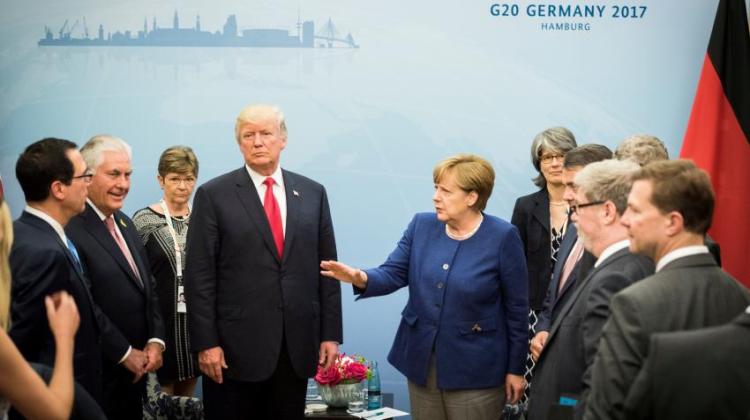
Trump Paris Agreement

World leaders were visibly upset that Trump would not concede on an international policy for climate change.

So what?

Although the words of caution from Holocaust survivors are obviously crucial warnings during such social upheaval, I’m not convinced that Hitler’s Germany and Trump’s America are synonymous. But perhaps I’m being cynical. Prof. Evans claimed there is one big difference between Hitler and Trump: while Hitler’s speeches and policies were exceptionally well-practiced, focused and deliberate, Trump’s tweets and policies are spontaneous, erratic and unguarded. This implies that Trump is not single-mindedly achieving some ultimate vision, but leisurely and arrogantly deciding grand policies without much foresight. As comedian Frankie Boyle quips, “Trump’s nothing like Hitler. There’s no way he could write a book.”

The good news? The violence from the neo-Nazi demonstrations in Charlottesville followed by Trump’s trivializing comments has forced Americans everywhere to defend their most basic national values, whatever they perceive them to be.

Trump may not be the voice for Americans everywhere – he certainly struggles to reflect the mood of the country – but at the very least he’s forcing Americans to have a conversation, a confrontation, of what it means to be American. He’s the proverbial trickster. A rousing ringleader. The grand master of controversy. The court jester who masquerades and provokes. The words that spill out of his mouth are not intricately prearranged, but reckless, and thus easier to destroy.

Fortunately, the greatest difference between 1930s Germany and today’s America is the lack of political violence by its leader. Whereas Hitler mobilized his Sturmabteilung brown-shirt henchmen to beat up political opponents in the streets, Trump has no such organized paramilitary government wing. Instead, Prof. Evans argues, political violence has taken the form of tweets and trolling, poisoning our political discourse.

But at the same time (and with the greatest respect, Prof. Evans!), Twitter, Facebook and other social media also allow everyone – Trump included – a political voice and online presence to confront ideas, create communities and mobilize politics. Smart phones allow people to record events like Charlottesville, so that those who promote hatred and bigotry are exposed. Modern communications certainly attracts trollers and hackers, but the brutal political violence that typified Nazi Germany is not what one experiences when they open their laptop, check their news, and write their blog. Thankfully.

Covefefe.
 

Why Save the Children’s Graphic Photos Still Work Today

There is a massive famine and outbreak of cholera currently in Yemen. The United Nations recently calculated that over 20 million Yemenis are in need of immediate assistance. To put this in perspective, Yemen is a country with only 28 million people. That means that two thirds of an entire country are suffering to such a degree to require international assistance. Incredible.

In the background of this massive crisis is a civil war. In January 2015, decade-long tensions erupted between a separatist group named the Houthis (a Zaidi Shia Muslim minority) and the authoritarian president Mr. Hadi. After the Houthis surrounded the presidential palace and placed the government under house arrest, Saudi Arabia intervened and is now leading another eight Sunni Arab states in a bombing campaign to restore power back into the Yemeni government’s hands. And civil war continues to this day.

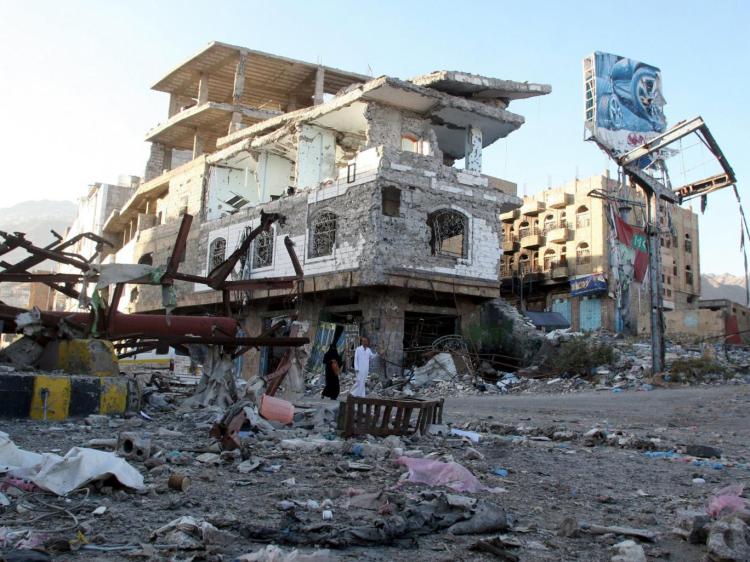
taiz-yemen

The city of Taiz has been ravaged by two years of battles between forces loyal to President Hadi, Houthi rebels and al-Qaeda

Importantly, a major port in the south called Hodeidah was seized by the Houthis. This port supplies Yemen with over 80% of its food imports. The Saudis won’t let relief ships dock there because the supplies would fall into the Houthis’ hands. This has delayed life-saving supplies for months.  Currently, the UN Security Council is trying to intervene to claim the port as strictly neutral. Let’s hope they can succeed.

In the last two years, hospitals and clinics have been destroyed. Government health officials have not been paid in a year. The basic necessities of life, like clean water and food, are a daily struggle to obtain. Cholera, which is spread by contaminated water, can kill within hours if untreated. By August 2017, it has infected more than 425,000 Yemenis and killed 1,900. And the situation is growing so severe that Oxfam calculates those infected with cholera could rise to more than 600,000 (which would exceed Haiti in 2011). The situation is obviously very grim.

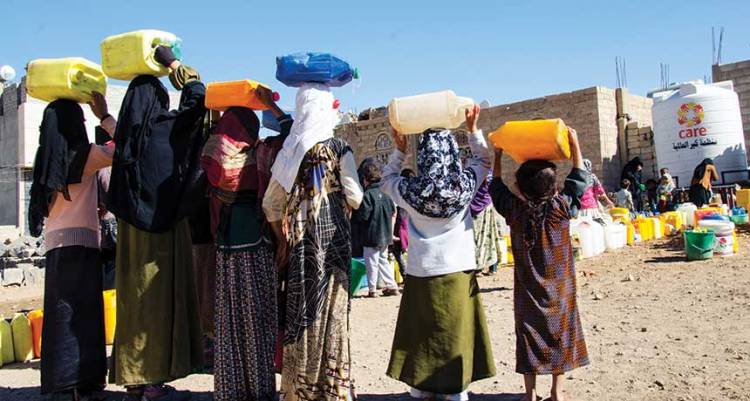
Yemen Cholera Water

These Yemeni women queue for clean water. Rowa Mohammed Assayaghi, a medical microbiologist at Yemen’s Sana’a University is teaching people how to wash their hands. “Focusing on health awareness is one of the most important measures to follow,” she says.

Calls for relief from various NGOs and charities are spreading throughout the West. I’ve noticed it more recently, even on my Facebook feed. But with more than one million malnourished children under the age of 5 living in areas with high levels of cholera, charities are getting desperate. Pictures of emaciated Yemeni children are now popping up repeatedly on news websites and social media everywhere. It’s heart-breaking to watch, and uncomfortable to see (especially after I Instagram my latest foodie pic).

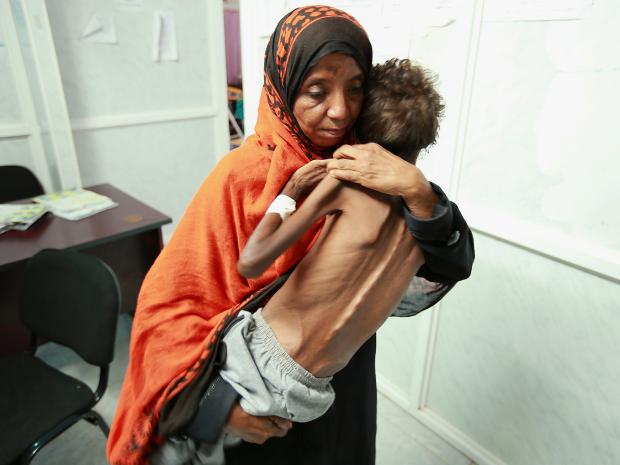
hodeidah-yemen starvation

A mother carries her son Imran Faraj, 8 year-old, who is suffering from malnutrition at a hospital in the port city of Hodeidah. This photo is from an Independent article in June.

When inundated with these grim photos, it sadly echoes so many other previous campaigns we may remember from past: AIDS orphans, Rwandan genocide victims, displaced children in the Sudan, starving children in Somalia, and so many others. But it’s effective. By pushing the suffering and starvation of the world’s absolute poorest children upon the western world, charities are using a remarkable game-changing strategy first used by Save the Children in the early 1920s. It changed both how we perceive children, and how we perceive ourselves. But first, the history…

Immediately after the First World War began, the Allies/Entente Powers blockaded Germany and Austria, meaning they did not send supplies, exports or any traded goods to their enemy. Much like Saudi Arabia is doing to Yemen today, blockading supplies was an effective economic weapon, especially against countries (like Germany) that depended heavily upon imports to feed its citizens.

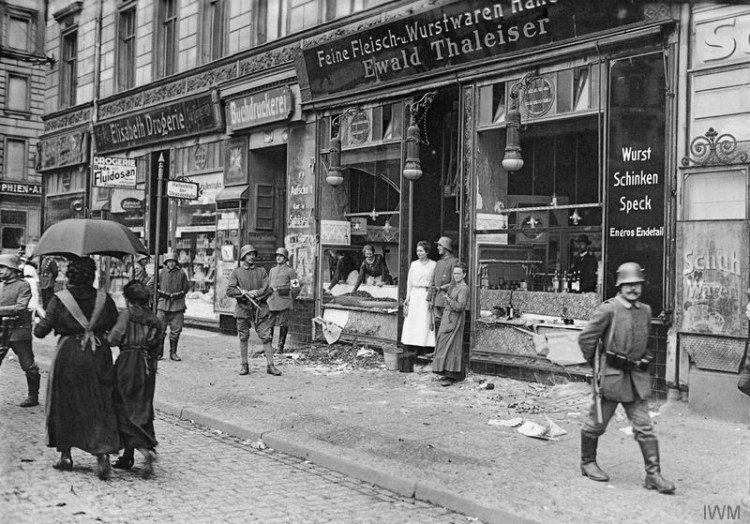
Blockade against Germany

A Berlin butcher’s shop is looted in 1919. A combination of bad harvests and incompetent regulation of food distribution, in addition to the British blockade, made the situation far worse.

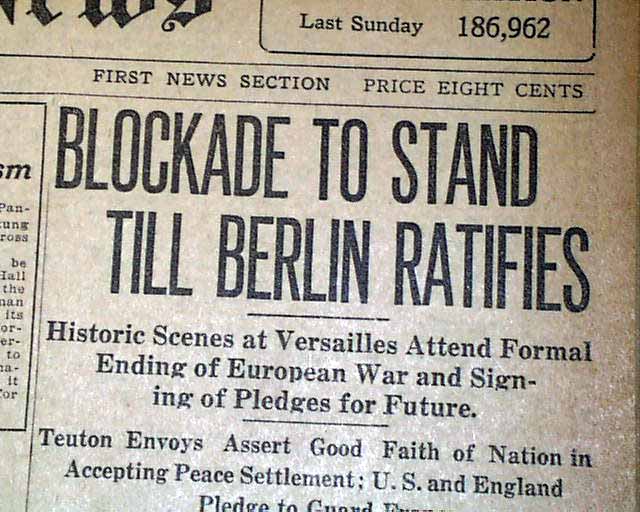
The First World War was slow-moving, hard-fought and resulted in massive causalities. An estimated 10 million people were displaced during the war. And despite the Armistice in November 1918, the food blockade against Germany and Austria continued and did not end until Germany signed the Treaty of Versailles in June 1919. That eight month period between the “end of war” and the “start of peace” resulted in mass starvation among the children of Germany and Austria.

For example, a Swiss doctor of the International Committee of the Red Cross, Dr. Frédéric Ferrière, reported that out of nearly 60,000 children examined in 1918 in Vienna, only 4,637 had been in good health. In other words, 93% of children were in bad health. (For more, see André Durand’s History of the International Committee of the Red Cross from Sarajevo to Hiroshima).

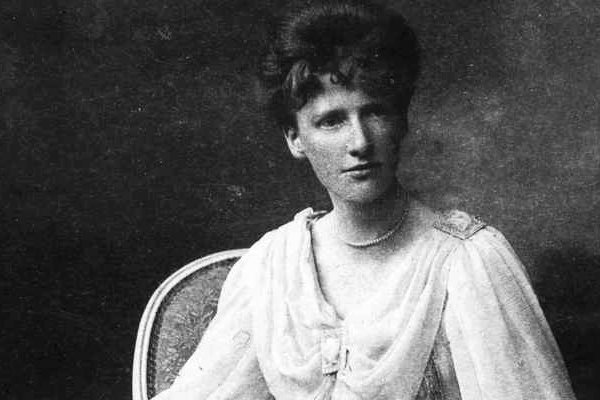
Jebb 2

Eglantyne Jebb (1876-1928) spent many years working for charities before founding Save the Children. Despite her good education and well-to-do British background, Jebb found that she was a poor teacher and not fond of children. Ironically, she became one of their chief champions in modern history.

Meanwhile, one of the first women educated at Oxford, Eglantyne Jebb, had worked for charities for years and was growing concerned about the fate of German and Austrian children under the blockade. We must remember that Germans (“the Huns”) were Britain’s national enemy for four long years. Thus, to overlook this and consider the suffering of the Germany and Austria’s children was quite remarkable. Jebb formed the Famine Council on 1 January 1919 with the direct desire to end the British blockade.

Newpaper Blockade 1919

The front page of the Detroit Sunday News on 29 June 1919

But Jebb soon discovered that her new council was not very effective. Numerous British charities were pleading for donations for various causes in 1919, such as for veterans returning home who were disabled and jobless, or countless families that fell into poverty after the war. Distributing leaflets with dense information, and by collaborating with churches and clubs to get members to donate, these various charities relentlessly campaigned for vulnerable groups. Jebb’s message was not only drowned out by the various other charities, but people were not rising above their national interests, their national prejudices, their national perspectives, to care for foreign children. Children, especially foreign ones, were often the last priority.

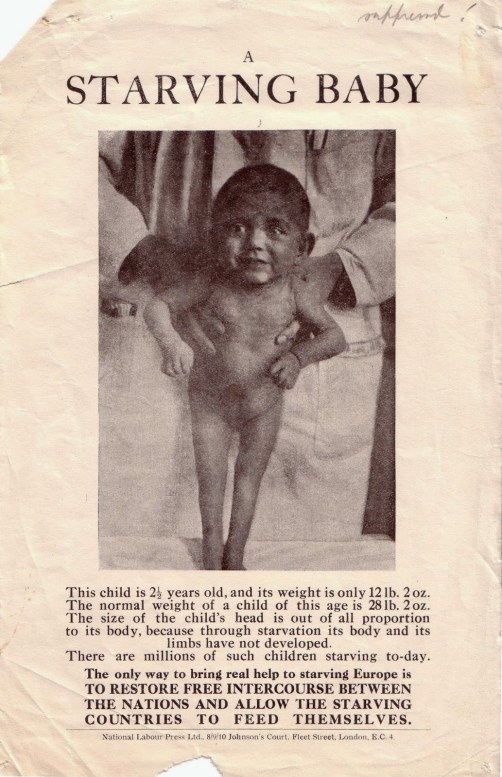
But Jebb and her sister, Dorothy Jebb Buxton, found a remarkable solution. They took to the streets of London and circulated a graphic “Starving Baby” leaflet. Instead of using dense text to explain her campaign to readers, Jebb plastered a large photo of a starving, desperate and pitiful 2-and-a-half-year-old Austrian baby on her leaflet. This image was haunting and even caught the attention of the local police. Although they were both arrested for spreading “unpatriotic propaganda,” Jebb (acting as her own attorney) argued the leaflets were not political, but humanitarian. The judge gave her a light fine of £5 and she reportedly felt victorious.

This was the beginning of a new type of campaigning. This was a new type of humanitarianism.

Starving Baby Leaflet

This leaflet was an unconventional way to provoke attention and revolutionised how charities campaigned for children. You may notice that Jebb does not identify the child as Austrian.

On 15 April 1919, Jebb founded the Save the Children Fund. This charity was the first to promote an abstract image of a “child.” It was the first charity to present children a symbol, an universal archetype, which were worthy of humanitarian relief, irrespective of race, nationality or creed.

Meanwhile, various noteworthy international organisations gathered in Switzerland.  They adopted neutrality and impartiality as a key strategy to facilitate relief and prevent further war. Even Save the Children moved its headquarters from London to Geneva symbolise its separation from political powers. Humanitarian historians Emily Baughan and Juliano Fiori claim that Save the Children’s apolitical approach meant that the “innate innocence and value of children (prevented) popular opposition to its humanitarian activities.” (“Save the Children, the humanitarian project, and the politics of solidarity,” in Disasters, 39 (S2): 132). For who, indeed, would oppose such humanitarian action for children?

Herbert Hoover’s relief programs, which had been incredibly successful in Belgium, also provided American food aid to Austrian children. However, relief was given in exchange for gold in 1919, which drained what little remained in Austria’s coffers in the aftermath of the war (see William E. Leuchtenburg’s Herbert Hoover). But Save the Children channelled its relief towards those same children without compensation or political gain.

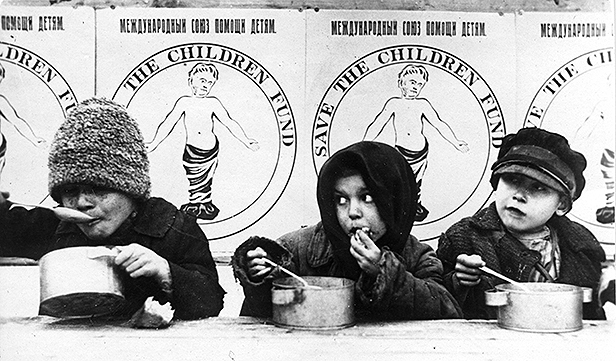
Save teh Children Russia

By 1921, when the Russian Civil War had produced countless refugees and starving children, the Save the Children Fund had found it’s stride. It campaigned on the big screen by showing films of the conditions children faced to British audiences. It was unlike anything else seen at the time.

By depoliticizing the Save the Children charity and the concept of suffering children, the response for famine relief for children was considerably successful, especially in Russia. Although no humanitarian organisation can ever be entirely apolitical (!!!), Jebb and Save the Children had found a way to overcome the nationalist and prejudiced perceptions of its donors. The archetypal child had been born.

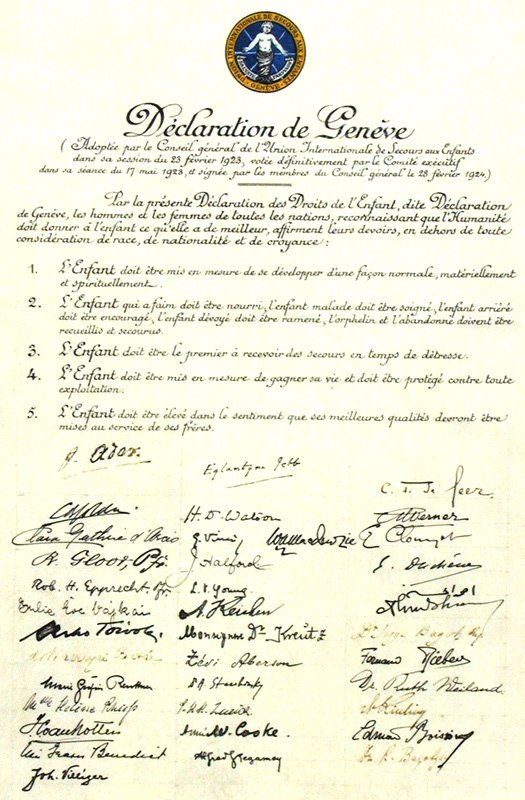
The idea of the “universal child” was also strongly defined by the Declaration of the Rights of the Child in 1924. Much like Moses descending from the mountain, the story goes that Eglantyne Jebb returned from a walk in the hills around Geneva and wrote five famous articles:

  1. The child must be given the means requisite for its normal development, both materially and spiritually.
  2. The child that is hungry must be fed; the child that is sick must be nursed; the child that is backward must be helped; the delinquent child must be reclaimed; and the orphan and the waif must be sheltered and succoured.
  3. The child must be first to receive relief in times of distress.
  4. The child must be put in a position to earn a livelihood and must be protected against every form of exploitation.
  5. The child must be brought up in the consciousness that its talents must be devoted to the service of its fellow men.
Declaration of Rights of the Child

Jebb’s Declaration (1924), pictured here, also formed the basis of the ten-article Declaration of the Rights of the Child adopted by the United Nations on 20 November 1959, some 40 years after the foundation of the Save the Children Fund.

On 26 November 1924, this Declaration was approved by the League of Nations. The members of the League were not obligated to integrate the Declaration into their own national legislation, so it did not guarantee any changes to national laws. But historian Bruno Cabanes (The Great War and the Origins of Humanitarianism, 1918-1924) argues that the 1924 Declaration singled out the protection and welfare of children as priorities for the international community and, ultimately, was more significant for its moral import than for its legal weight.

So what?

The methods of Save the Children really has saved the children. Due to the Jebb’s honest, graphic but highly impartial approach, children from all over the world are valued, regardless of their race, class or religion. Although this may not guarantee that everyone generously donates to children’s charities, it does, at the very least, overcome many nationalist and racial prejudices. And, what’s incredible is that it’s still effective today! Whether it’s a starving Austrian child due to a blockade, a African orphan of AIDS,  a drowned Syrian child on a beach, a war-stricken bombed out boy in an ambulance in Aleppo, or now Yemeni children with cholera in the midst of civil war, we can go past many labels and prejudices to see them for what they are – children.

To a certain extent, this also changes how we perceive ourselves. By promoting the concept of the “universal child” it also simultaneously reinforces the concept of a “universal guardian.” Human cultures fundamentally protect and provide for society’s most vulnerable members.  By reacting to these images of starving children with dismay and shock, and by feeling a sense of injustice, then the viewers are also imparted with a sense of responsibility. Children cannot protect or provide for themselves so we – the guardians – must intervene.

Children’s rights today are still evolving world-wide. Over 100 million children work in hazardous conditions and have no access to education. Thousands are child soldiers. Some states imprison children as young as 12 years old. Over half of today’s 65 million refugees are children.

Although Eglantyne Jebb may have been discussing starving German and Austrian children, her words are still present in today’s campaigns for Yemeni children: “The only international language in the world is a child’s cry.”